Abinger – the oldest village in England
Given that Abinger can lay claim to the title of the oldest village in England, it seems fitting that the annual village celebration, The Old Fair of Abinger, draws heavily on the past. That claim can be made due to the presence of a Mesolithic pit dwelling in the field just below Abinger Manor.
In the 1940s and 50s Abinger Manor and Raikes Farm were leased by Edward Beddington-Behrens and his wife Irena, a Russian Princess. When the fields around the Manor were deep ploughed, Edward noticed many flints were being turned up and so he began documenting exactly where they were. In 1950 he invited Dr. Louis Leakey and his wife Mary, both famous Palaeontologists who had discovered man’s earliest ancestors at Olduvai Gorge in Tanzania, to come and help him to excavate the site. Over a very wet spring in 1950 with a large tent covering the site, they discovered the pit dwelling and built a small museum to house the flints and tell the story. In Leakey’s words:
‘Sheltered behind a low hill, Mesolithic hunters approximately 10,000 years ago created a village of pit dwellings for occupation during the winter months. This is a rare example of winter habitation of these Mesolithic people. It is in fact the only complete and undestroyed pit dwelling of this stone age cultural period known as the Horsham Variant of the Tardenoisian culture.’
When the Clarke family moved to Abinger Manor they took over the care of the museum and have welcomed visitors from all over the world, as well as many school parties. Cherry Clarke still retains this responsibility to this day and is always happy to show it to any interested, historically curious visitors.
Churchyard Fairs – a very old English village tradition
Churchyards were traditionally places of assembly and trading, a practice which can be traced back to pagan times and the Churchyard Fair was the opportunity for local people to bring their cattle to trade and to make merry. There is little doubt that Churchyard Fairs were held in Abinger for hundreds of years.
At this time people were allowed to graze their cattle on the common land around their homes which led to a very different landscape with many fewer trees in the area than we have today. The cattle plague of 1860 significantly reduced the number of cattle and the simple agricultural peasant life was also under threat from industrialisation leading a number of families to leave Abinger to seek a better life in the new world. All of this is well evidenced by Richard Redgrave’s painting of Abinger Bottom in 1858, The Emigrant’s Last Sight of Home which is owned by the Tate Gallery in London. While the importance of cattle trading at the Fair had all but died out by the end of the 19th Century the annual merry-making continued. However, even this was to come under threat in 1889.
After an afternoon of entertainment with swings, coconut shies and a game called “Knives and Rings” which had proved very popular but might not pass the Health and Safety rules of the 21st Century, dancing was due to begin on the Green at 8pm. As the Abinger Hammer Drum and Fife Band struck up on the Green, they were interrupted by Mr John Rowberry, a Church Army Captain, who led a group of 3 or 4 women singing hymns in protest against the sinfulness of the enjoyment of the Fair. The evening was saved by the landlord of the Abinger Hatch, Mr Muggeridge who escorted Mr Rowberry and his pious singers from the Green and dancing continued until 11pm that night. The organisers of the Fair were in no way chastened by Mr Rowberry’s protest and the following year, 1890, the Fair lasted for a full two days.
Abinger Pageants
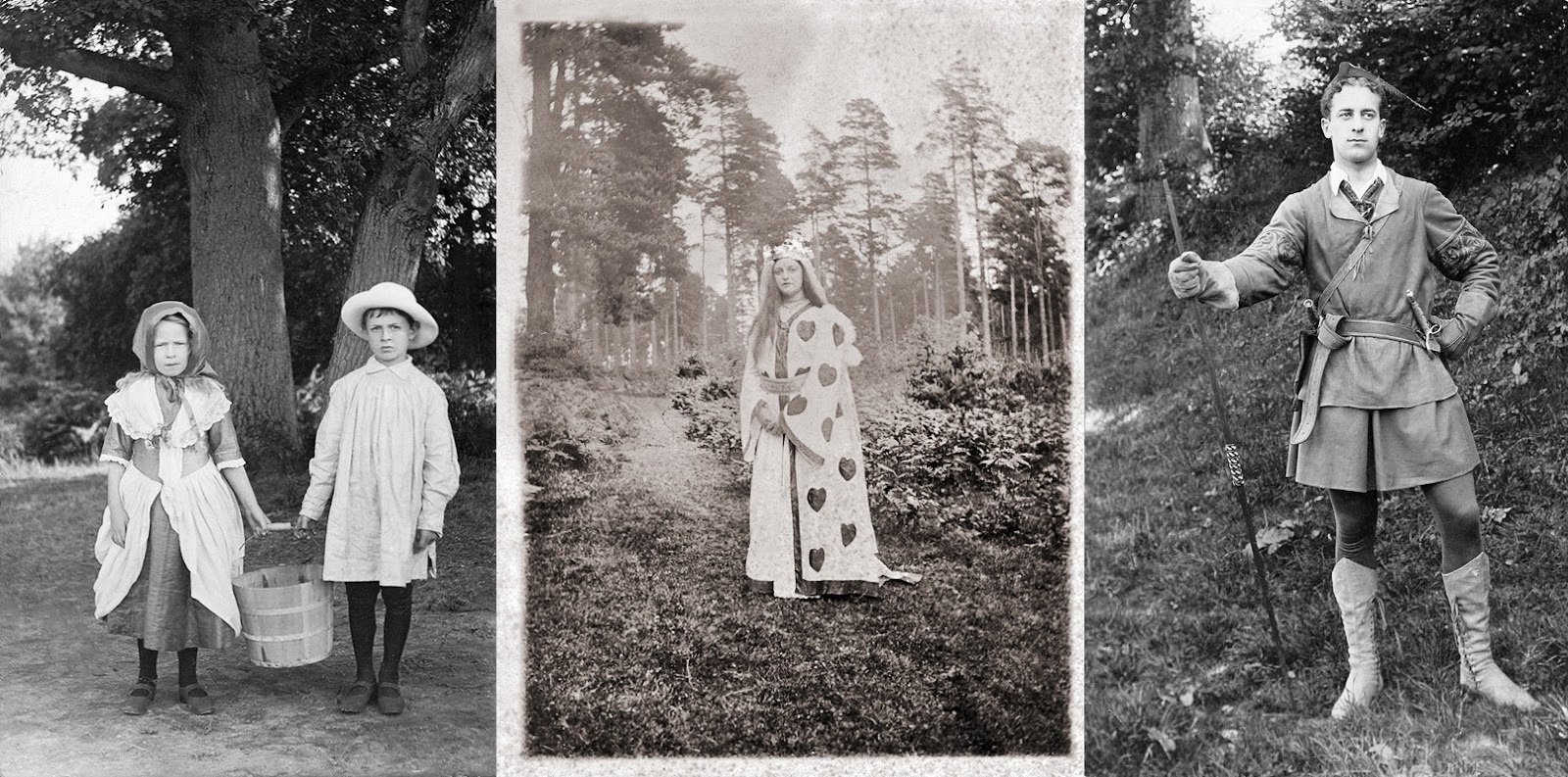
In the early 20th Century, the traditional Churchyard Fair seems to have died out and by the late 1930s it was more of a fun fair with rides and side shows. However, a number of pageants were organised between 1902 and 1963. The most ambitious of these was held in 1934 at the Abinger Rectory (now the Old Rectory) in Donkey Lane and had 400 participants including a band and a choir involved who dressed up and reenacted scenes from local history. The Pageant was written by E. M. Forster (the famous novelist) who had moved to Abinger with his mother 10 years earlier having inherited his aunt’s house, West Hackhurst. The Pageant included music by Ralph Vaughan Williams who had been brought up at Leith Hill Place. The last pageant took place in 1963.
1956 – The Old Fair of Abinger was authentically revived
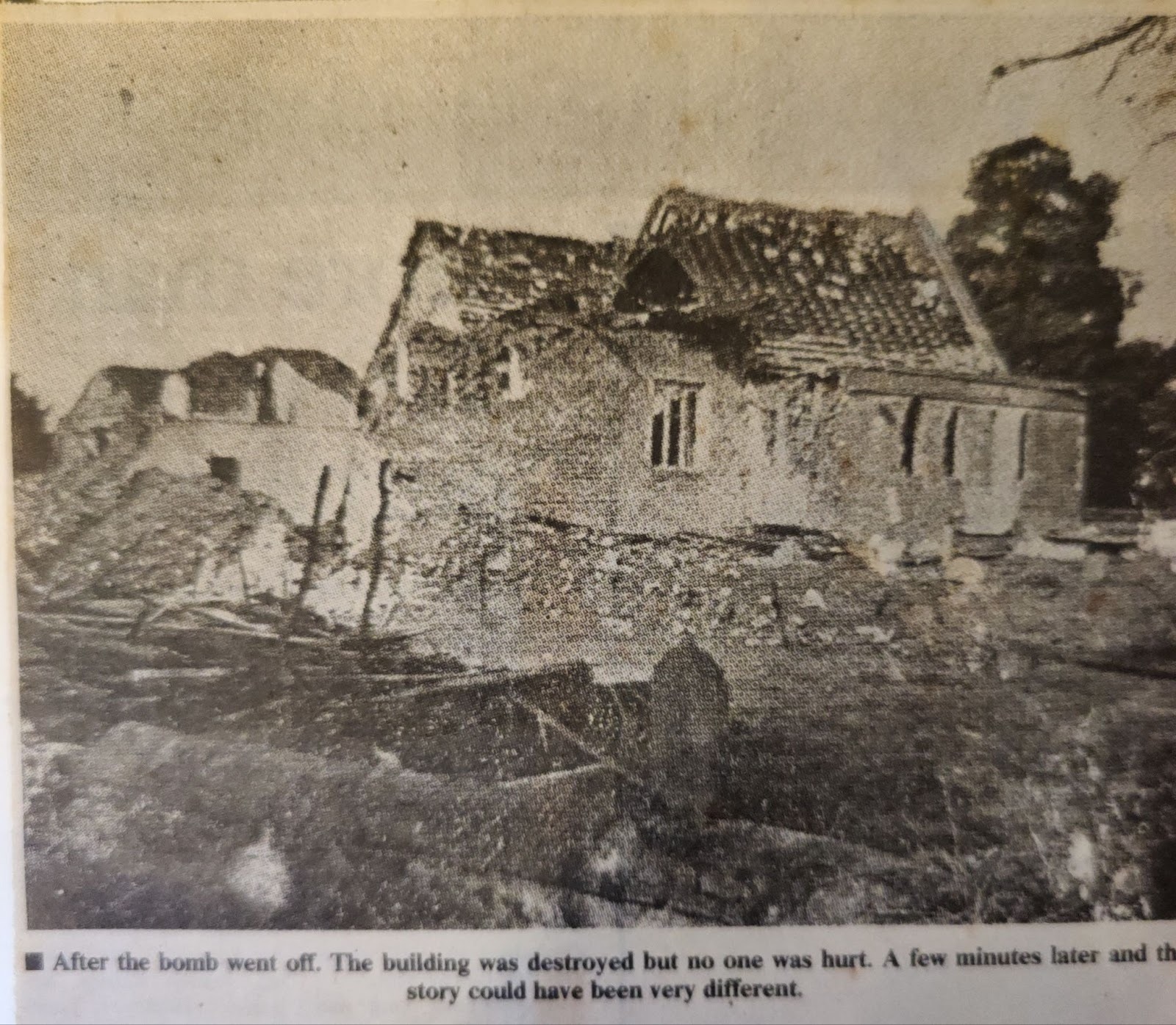
World War 2 came to Abinger on 3rd August 1944 when a flying bomb landed on St James’s Church causing considerable damage, and its costly restoration was completed in 1951.
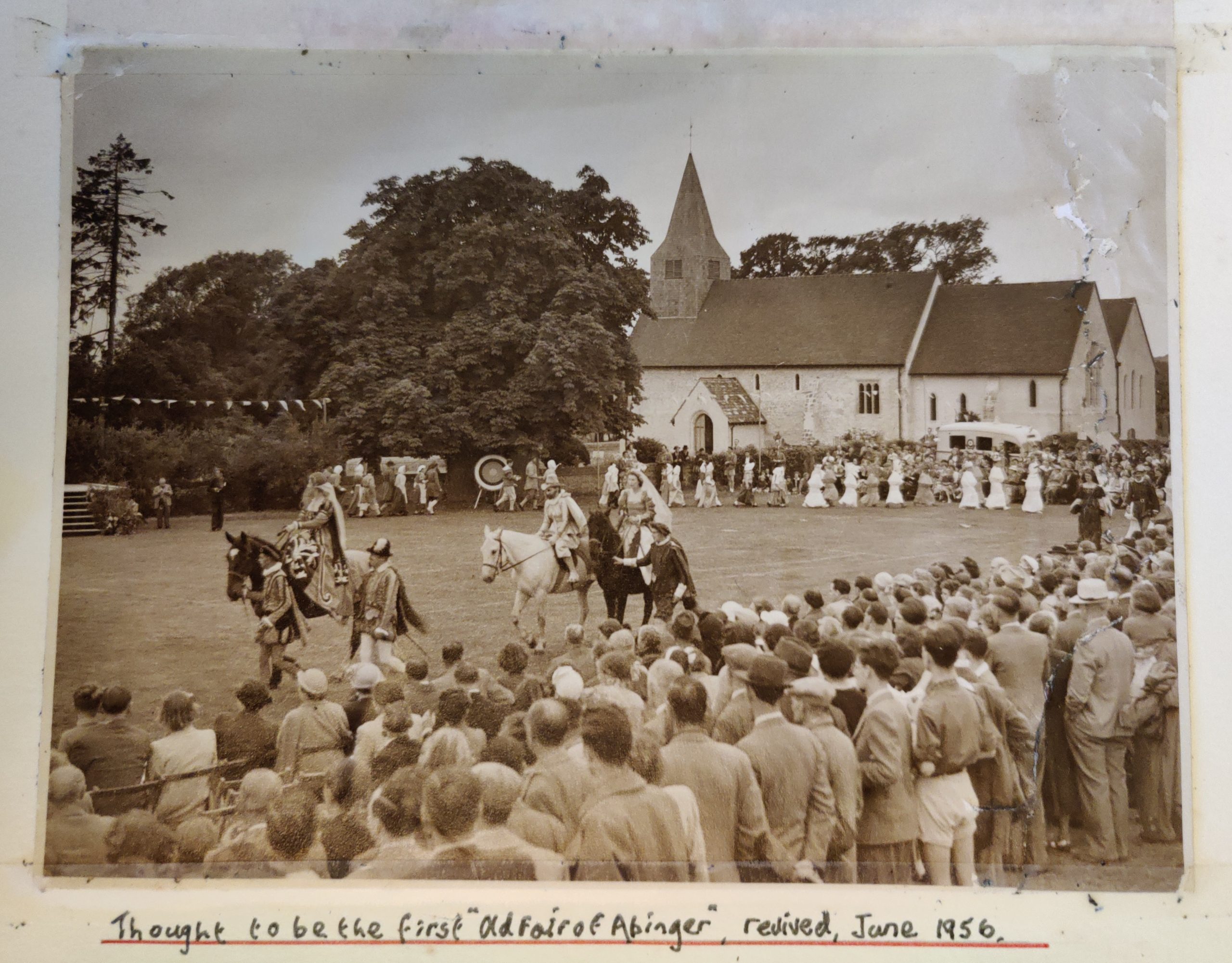
The then Rector of St. James’, Dr Clifford Thomas Chapman decided to revive the tradition of the Churchyard Fair, and the first Old Fair of Abinger was held in 1956 as a fundraiser for the Church. It has been held annually ever since then (except for the Covid years of 2020 and 2021). After just a few years profits were donated to local charities and amenities as well as the Church. Initially the Fair was held on St. James’ day which is 25th July but the modern revival soon deemed that this date was too close to school holidays and brought it forward to the second Saturday in June.
Pilgrims Way?
When Dr Chapman revived the Old Fair of Abinger in 1956 much was made of the fact that such fairs had been held in times gone by to offer food, drink and entertainment to pilgrims and indeed the Pilgrim’s Way runs only a couple of miles from the village and so it seems possible that Abinger Fair may have fulfilled this tradition in medieval times. Terence O’Kelly, our most authoritative local historian doubts that this is the case. Firstly the Pilgrim’s Way was a name first used by a Victorian historian, Martin Tupper, who renamed what had previously been called the Drove Way which runs along the North Downs. While the route was undoubtedly used by pilgrims on their way to Canterbury, O’Kelly suggests that it seems unlikely that those pilgrims would have heard of the small cattle fair taking place in Abinger and even less likely that they would have made a 2-3 mile detour to get there. Whether true or not the pilgrim story has been told so many times now that it has become a reality for the village.
Medieval Traditions
Dr Chapman and his team organised activities consistent with the medieval theme – darts, skittles and casting the stone as well as less recognisable events such as cambuc, a medieval cross between hockey and golf, and hen-baiting, although the programme indicates that this activity was modified according to RSPCA requirements. The members of Abinger Youth Club had a competition to see who could climb highest up a greasy pole and there was a demonstration of medieval bowls.
The Court of the Pie Powder was another revival from the Churchyard Fairs. The name comes from the French “pieds poudres” which literally means dusty feet. Trade and other local disputes were tried by the court and those on the losing side would end up in the village stocks.
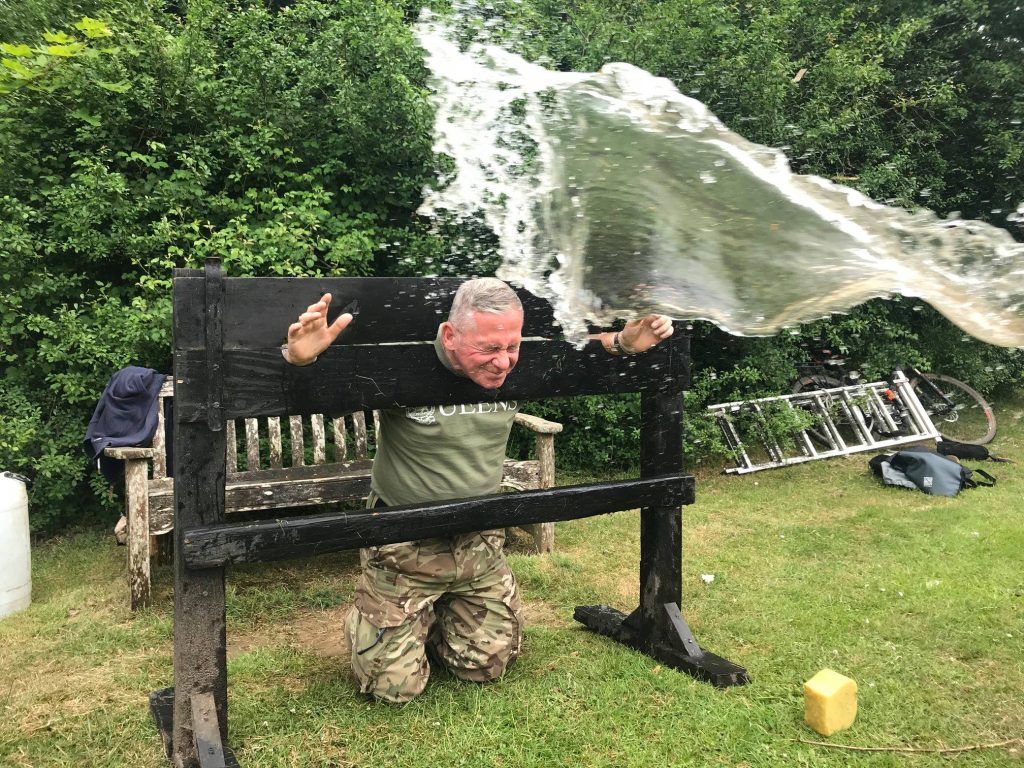
While there were stocks still in the village, they were in such poor condition that new stocks were commissioned and these are the ones that remain on the Green today.
Medieval Costumes
To match the authentic range of medieval activities, villagers were asked to dress as authentically medieval as possible and volunteers were sent to research rural modes of dress, the cloth and the dyes which would have been seen in medieval times. Homespun was the key word for apparel and the colours would have been those from nature. Bolts of hessian (sacking) were ordered from the mills and were then dyed drab colours. Designs were similarly simple. Men would wear a length of sackcloth cut at the fold to allow the head to go through and then sewn at the sides with a gap for armholes and gathered in by rope. Legs and feet were bare apart from simple sandals. Hats were also design free so a squashed trilby with a few pheasant feathers or the wife’s beret pierced with a long quill were all acceptable. Women were similarly attired but to the ankle and a blouse could be worn underneath adding some femininity. Head-coverings were any bonnet design but nothing fancy.
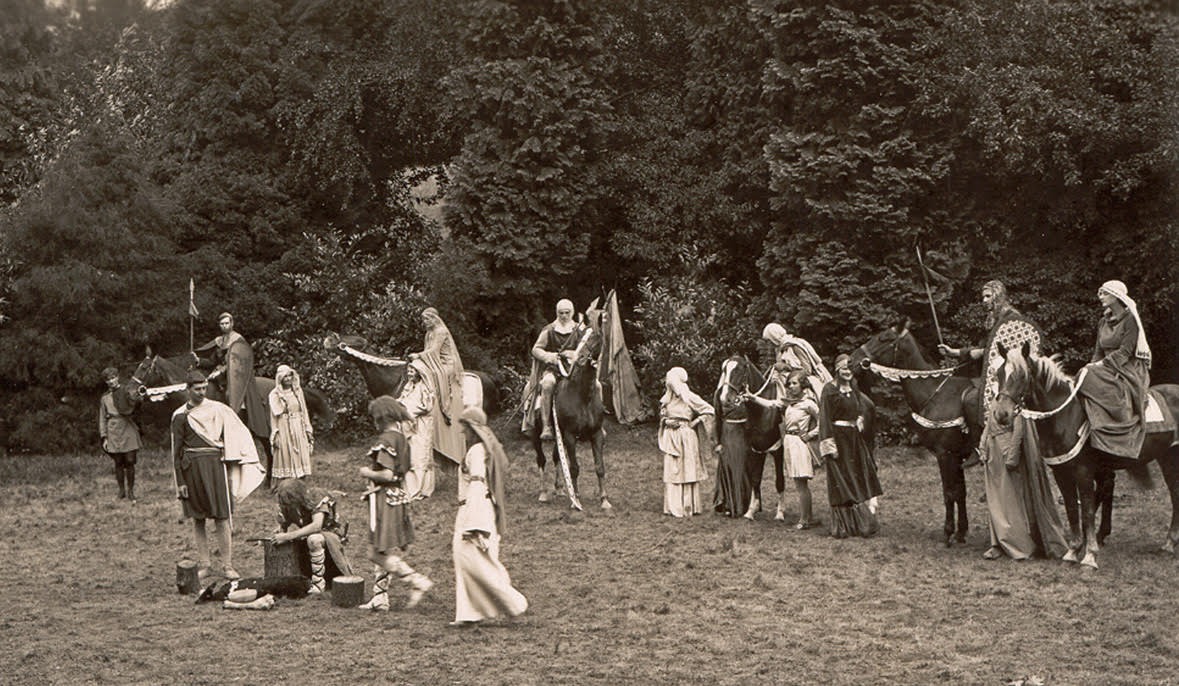
This authenticity continued for a few years but by the early 1960s vanity got the better of many villagers who modified fair costumes to be a bit more flattering but still roughly pertaining to the period. Wimples began to appear; colours became brighter and gradually the village adopted the look of medieval gentlefolk rather than the simple peasants who would have lived in Abinger in the Middle Ages.
A dramatic turn of events in 1964
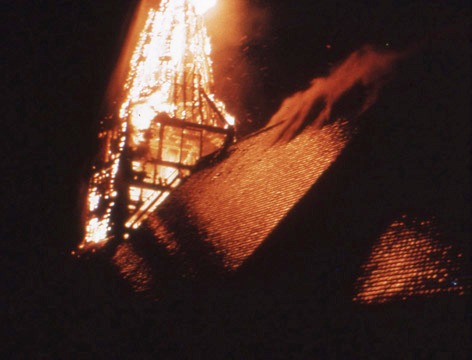
In 1964 preparations for the Fair took a dramatic turn. During the evening of Friday 12th June, a violent storm hit the village with thunder, forked lightning and torrential rain. The Clarke family who lived at Abinger Manor had a large house party and the storm was so violent that they all went to the windows to watch from every angle. One guest went to the library which looked on to the Church and asked the Clarkes whether the Church was always lit up at night. The family quickly realised that the Church was on fire. Just after midnight, lightning had struck the lower part of the spire of St. James’ and very quickly the wooden spire was engulfed in flames.
Mrs Joy Clarke called the fire brigade who responded quickly, as did the house party from the manor and many other villagers, who rushed to save whatever they could from the blazing Church. This included a number of heavy wooden pews that were dragged out in the rain. Having been hampered by low water pressure, the fire brigade resorted to taking water from the village pond and it was 4.0am before the fire was under control and the villagers retired to the Abinger Hatch for well-deserved brandies. Just a few hours later dawn revealed extensive damage to the roof and the spire. In a sad twist, the 300-year-old bells that had managed to survive the bombing almost exactly 20 years earlier melted in the intense heat.
Despite their fatigue, having spent half the night trying desperately to save the Church, the villagers were out the next morning to prepare for the Fair.
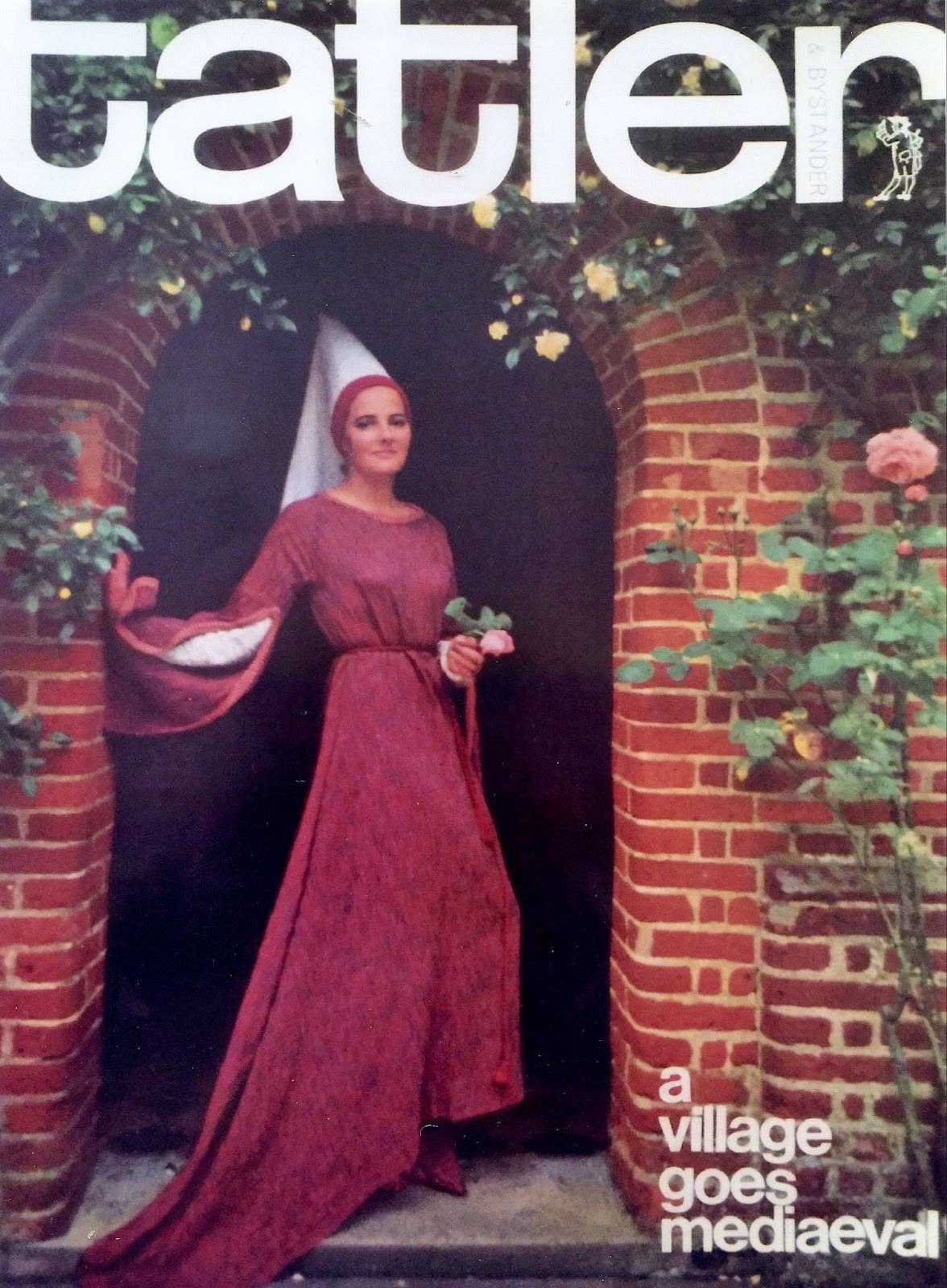
This dramatic incident came to the attention of the National Press and a well-known photographer, Richard Swayne, who had recently been employed by ‘The Tatler’ was sent to take photographs. At Abinger Manor he came across the young fiancée of Robert Clarke, Cherry, who embraced the traditions of the village she was about to move to and dressed for the Fair very elegantly in a flowing red dress complete with a train and long sleeves topped off by a tall white cone shaped hat also with a train. The image of Cherry in the doorway of Abinger Manor was used for the cover of August 1964 edition of the Tatler. And inside the magazine was an article entitled “A village goes medieval”.
In the busyness of preparations for the Fair, the fact that the photograph had been taken was forgotten and indeed the article might not have been noticed if it had not been for Cherry’s father. He came to the UK from his home in Kenya where he had found that his morning suit, which he was to wear for his daughter’s marriage to Robert Clarke of Abinger, had been eaten by insects. He had to go to Moss Bros for another suit and while he was waiting to be measured, he was given a magazine and exclaimed “I think that is my daughter”. Sadly, another result of the fire, was the fact that Robert and Cherry could not be married at St James’ as had been planned but their wedding was moved to Wotton where Bishop Reindorp officiated and promised the young couple that St. James’ would be rebuilt.
Robert and Cherry lived in the village thereafter, taking the Manor over from Robert’s parents and Cherry went on to become Chair of the Abinger Fair Committee. Robert has since died but Cherry still lives at Abinger Manor Cottage and attended every Fair for 60 years since coming to the village in 1964.
The fire brought much attention to the village and to the annual village fair such that by the late 1960s announcements were being made at local train stations as well as on local radio. Of course, in those days people were much more intrepid and often were dependent on local transport. The fair programme of 1968 gave the following directions… “412 Bus from Dorking to Parkhurst Corner. 425 Bus from Dorking or Guildford to Wotton Manor Farm or Crossways Farm.”
A ghostly appearance
A particularly memorable figure from this era was John du Bois who lived in the middle of the village and dressed for the Fair in a full suit of armour such that he could be heard clanking around the village green. Mr du Bois was a great fan of the mead served at the Bar and partook fully such that by early evening, he needed a bit of a rest and choose to settle on a grave in the Churchyard. He only woke at closing time when the rowdy drinkers leaving the Abinger Hatch came face to face with a knight in full armour rising from one of the graves and began to wonder just how much they had drunk themselves that evening.
The Fair achieves worldwide fame
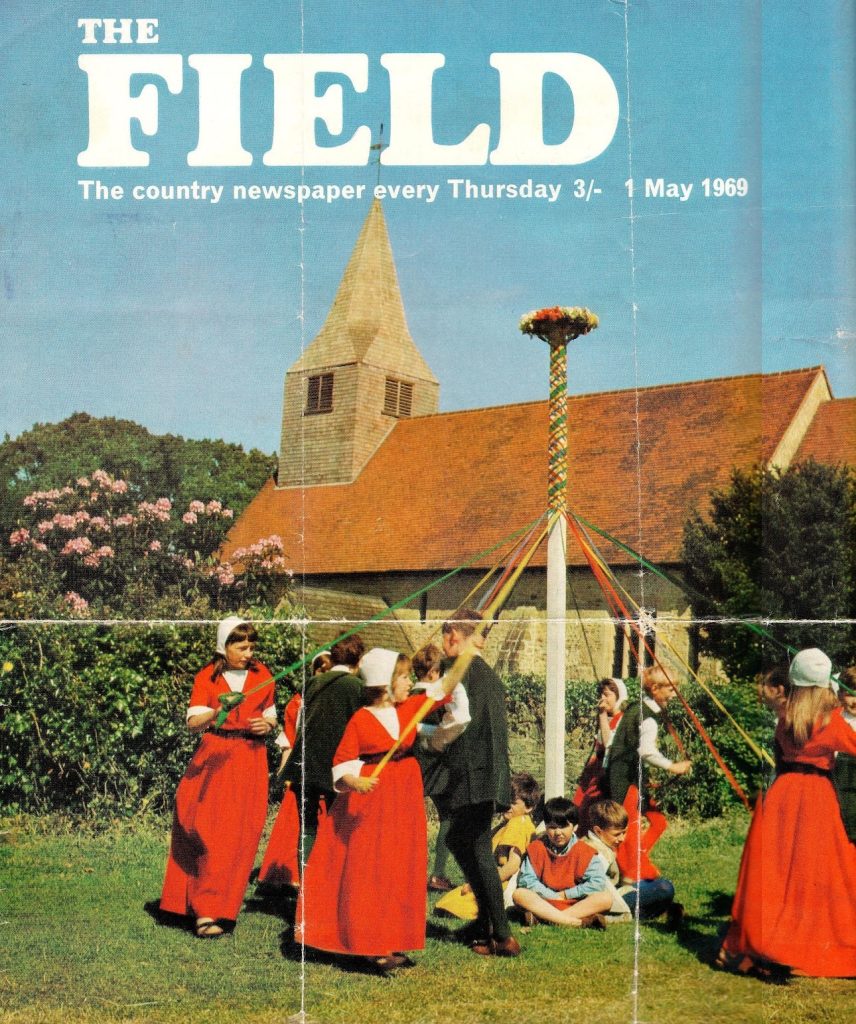
Throughout the 1960s, the Fair continued to attract the attention of national publications such as The Field, In Britain and The Lady.
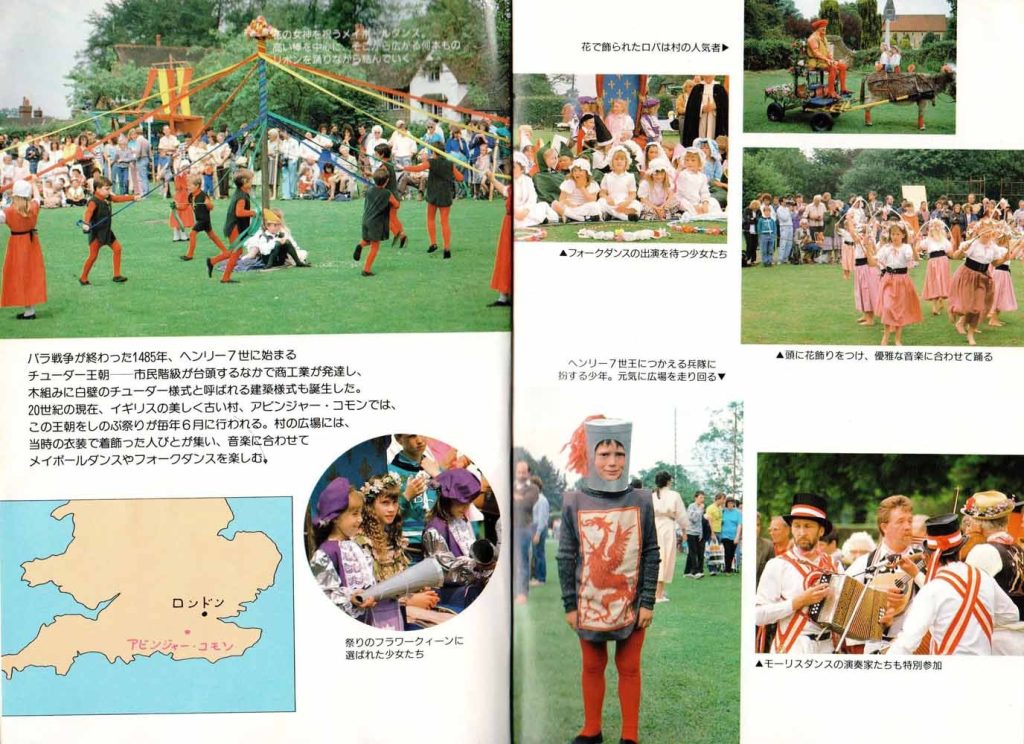
Although no one was quite sure how or why, in 1988 the increased publicity brought The Old Fair of Abinger to the attention of the Japan Airlines in-flight magazine and much to the surprise of the car park attendant that year, a coach full of Japanese tourists turned up and space was eventually found for the coach in the driveway of Abinger Manor. Apparently, the Japanese particularly appreciated English scones and left happy.
Shenanigans before the days of Health & Safety
In the early days the Fair could be much less attentive to Health & Safety issues but fortunately even when mishaps did occur no one thought to sue the organisers. One year the Wandsworth Police Dog Handling team were invited to put on a display in the Arena and they staged the pursuit of an armed criminal. During the demonstration the criminal turned and fired his gun. Of course, the gun only fired blank pellets but nevertheless a woman in the audience was “shot” and left with a nasty bruise on her upper arm and everyone was very relieved that the blank had not hit one of the many children sitting around the edge of the arena. When they were challenged afterwards, the Police apparently said they hadn’t thought of that. Fortunately, it is difficult to imagine such a thing happening today.
Another popular activity was pillow fighting while sitting precariously on a long tree trunk. A couple of local ladies set at each other quite viciously (maybe an old score to be settled?) and eventually one of them was forced off, landing heavily and breaking her arm. Not surprisingly that was the last year that activity was allowed.
Jousting is always a popular medieval pastime. Joanna Durham, the current Chair of the Fair Committee, witnessed jousting in her first year at the Fair and while it was spectacular, the sight of a knight on a charger at full gallop with a large lance trying to stop his horse in time so as not to plough through the children at the arena’s edge was sufficiently disturbing that it means that we won’t see that again on her watch.
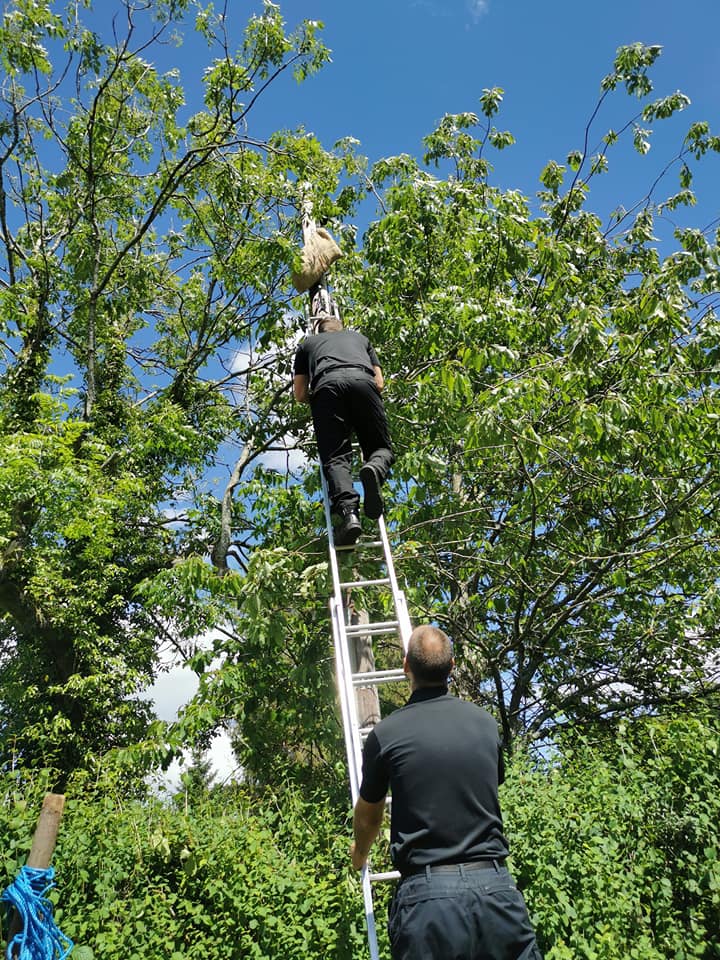
Tossing the sheaf over a bar is always popular and becomes extremely competitive. In 2023, the sheaf was thrown with such vigour that it landed on the telephone pole adjacent to the Green and could not be dislodged. The only solution was to call the Fire Brigade
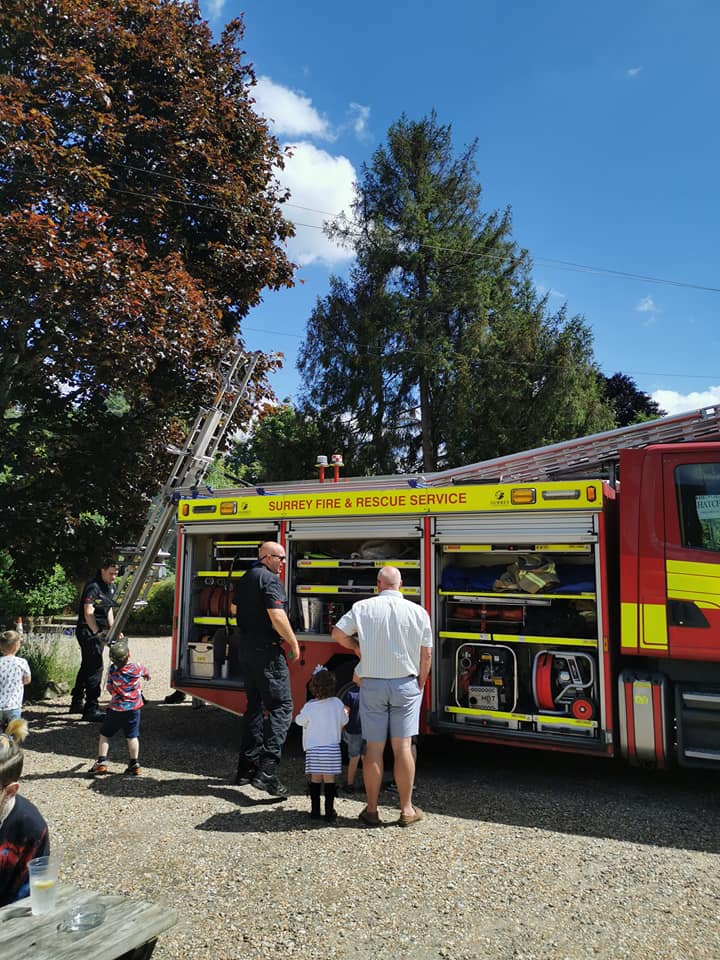
Having solved the problem, the fire engine remained to the delight of the children, while the firemen tried unsuccessfully to beat the locals at tossing the sheaf.
The Old Fair of Abinger unifies our village
Ultimately the Fair is an amateur affair on a limited budget which depends entirely on the goodwill of the whole village and as such it brings us all together once a year. Since the Fair began the village has lost its shop and post office and more recently the village school which makes it all the more significant for the village of Abinger as a whole.
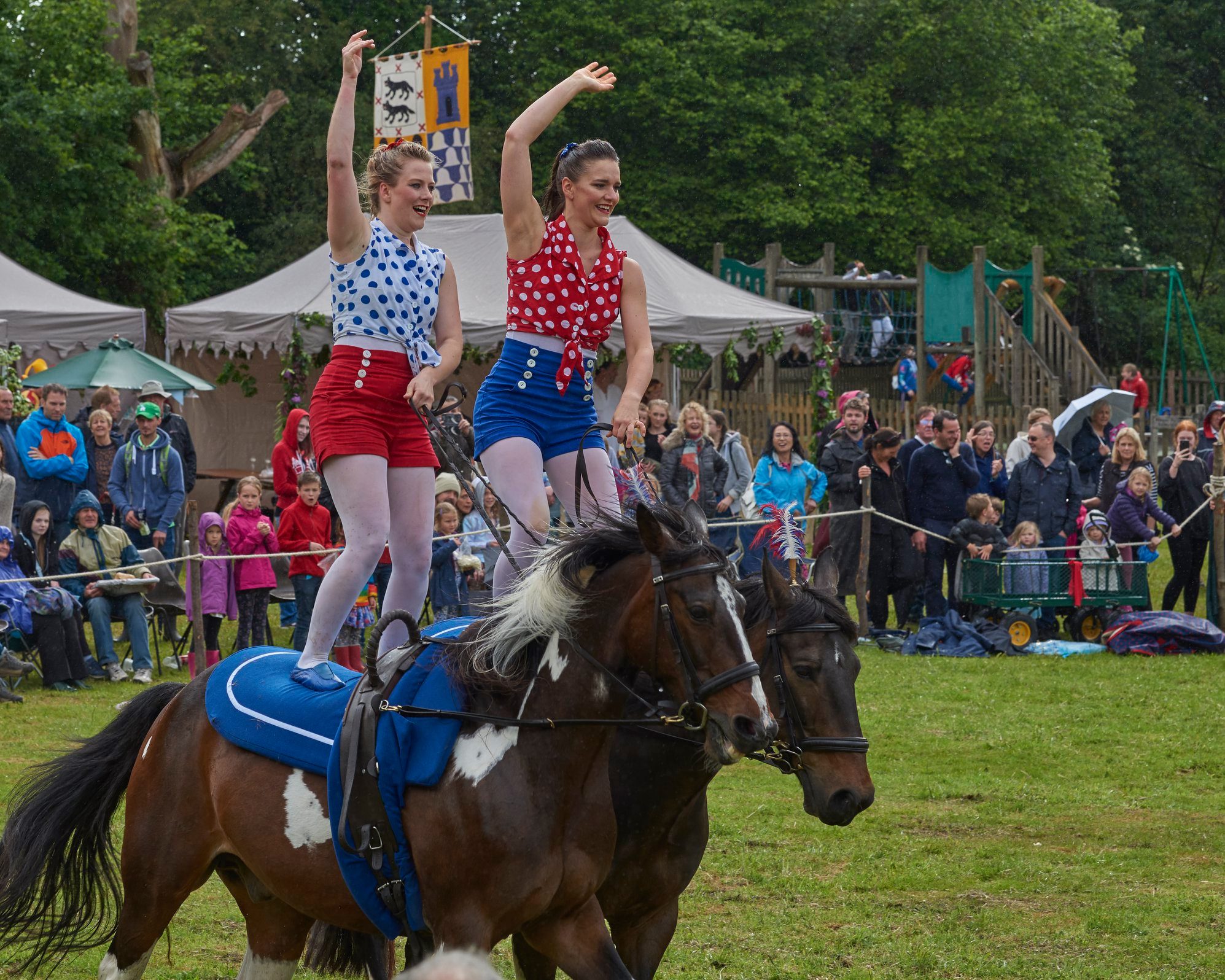
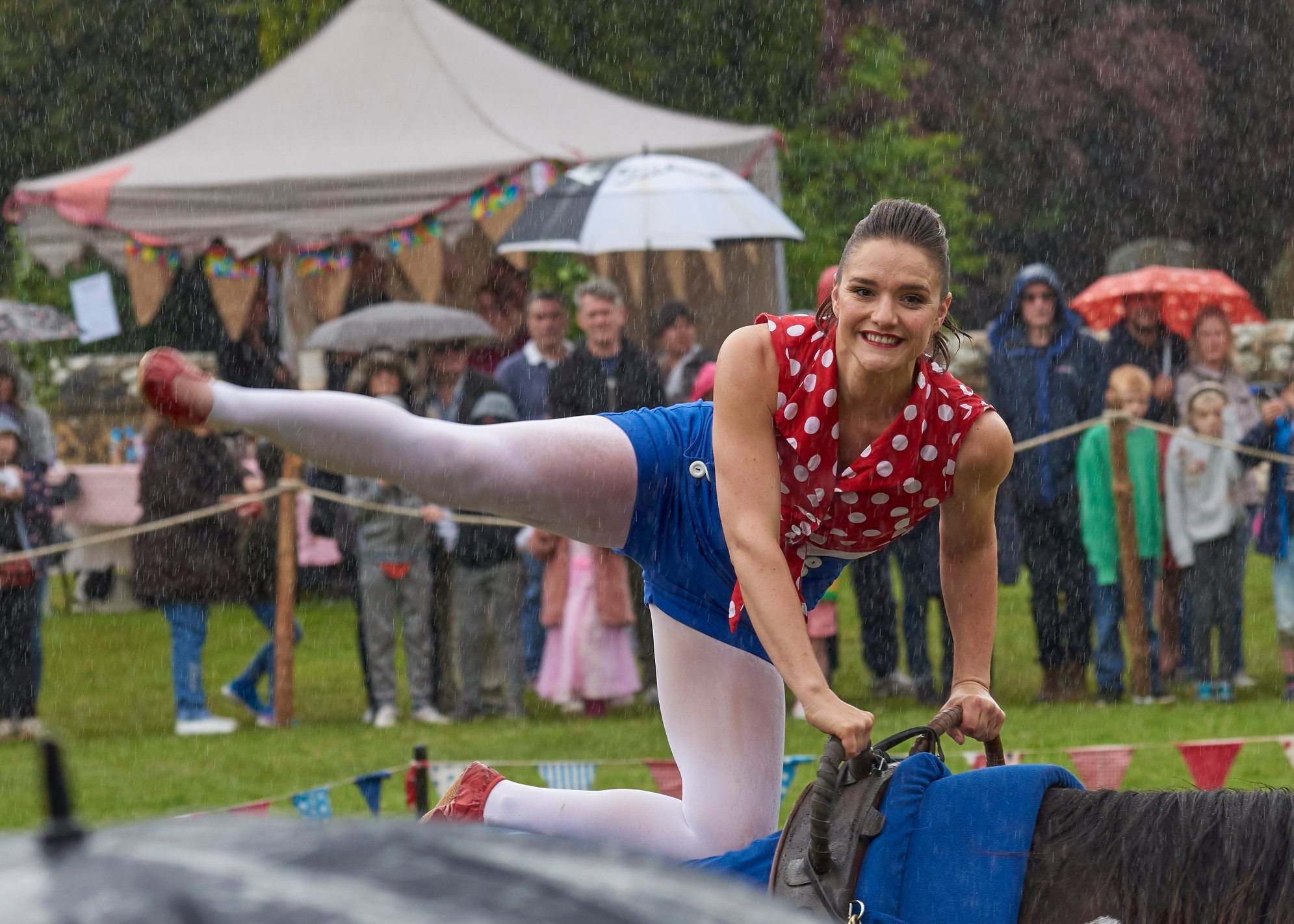
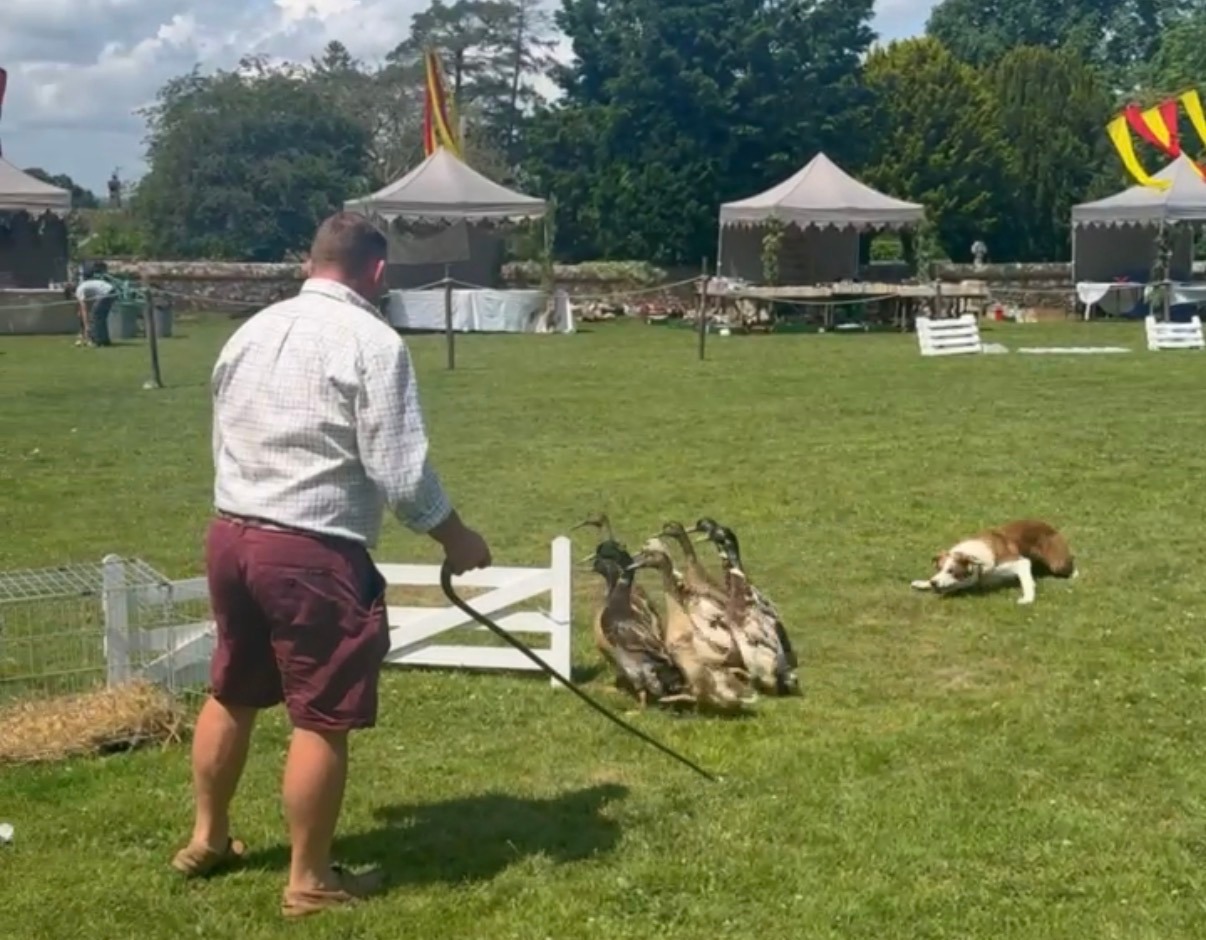
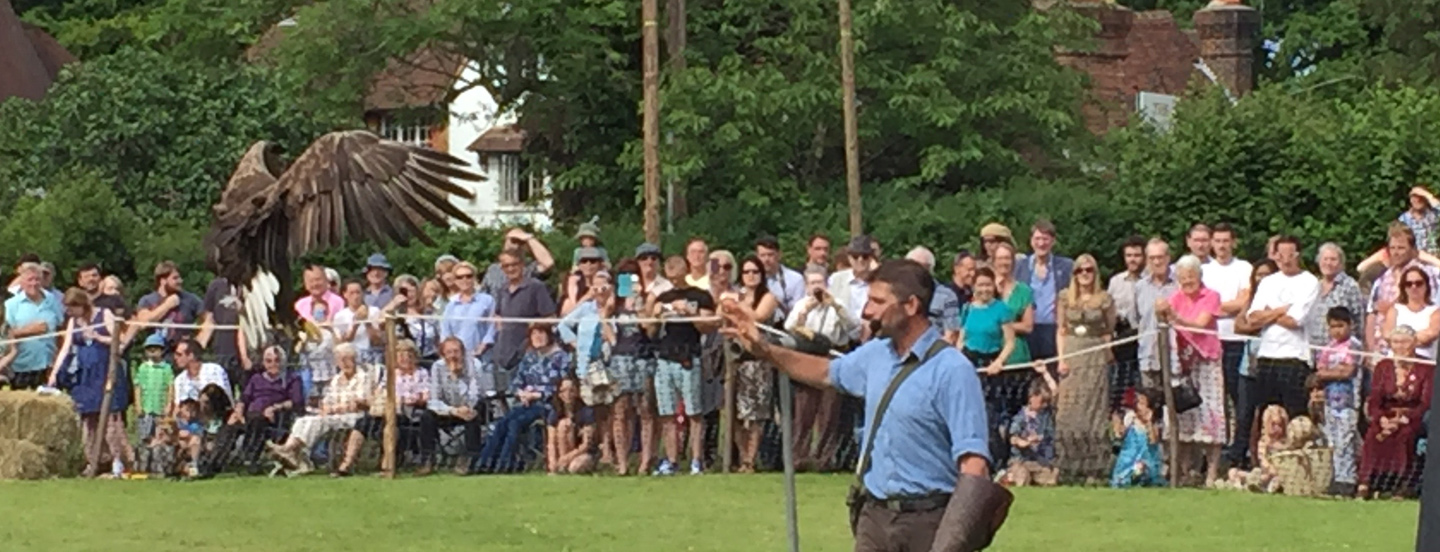
While we have had many wonderful Arena displays, much more memorable have been the birds of prey who have flown off, the horses who have refused to follow orders and pigs and terriers who have gone in the wrong direction.
From Strength to Strength
Since the 1956 revival the Old Fair of Abinger has gone from strength to strength. In 1967, the Fair raised almost £1,000. In 2025, the Fair took over £25,000 and was able to donate a significant amount of that to local charities and amenities.
The Fair depends completely on the support of a huge number of villagers who work tirelessly to make it a fun day out for all and to raise money for many local causes. It has been an Abinger tradition for many, many years – long may it continue.
Written by Kim Clark, Spring 2026
With thanks to the Abinger residents who have attended 50 fairs or more and kindly shared their memories – Di Prideaux, Cherry Clarke, Sue Bouchier and Sonia Babister. Thanks also to Phil Rawlings who has adopted the role of archivist for the village.